The Five Pillars for Exponential Impact
Companies are key actors in the net zero transition. Currently, corporate climate action is focused on reducing emissions from operations and value chain. But, achieving these reductions is dependent on the world transitioning around them.
The Exponential Framework is a strategic framework that captures the opportunities companies have across 5 Pillars: Reducing impact and Enabling transformation.
The first two pillars address what your company emits, reducing direct emissions from your operations and across your value chain. The other three address what your company enables: the low-carbon solutions you build and scale, the capital you direct toward the transition, and the policies and narratives you have the power to shape. Together, they represent the full scope of corporate climate power, from the emissions you control today, to the systems you help transform tomorrow.
Most corporate climate programmes focus on the first two pillars, reducing operational and value chain emissions in Scopes 1, 2, and 3. These are essential, but most net zero targets cannot be achieved by a single company alone. Pillars 3, 4 and 5 are where companies both drive and depend on collective action to transition: building solutions, mobilising finance, and advocating for the system changes their targets require.
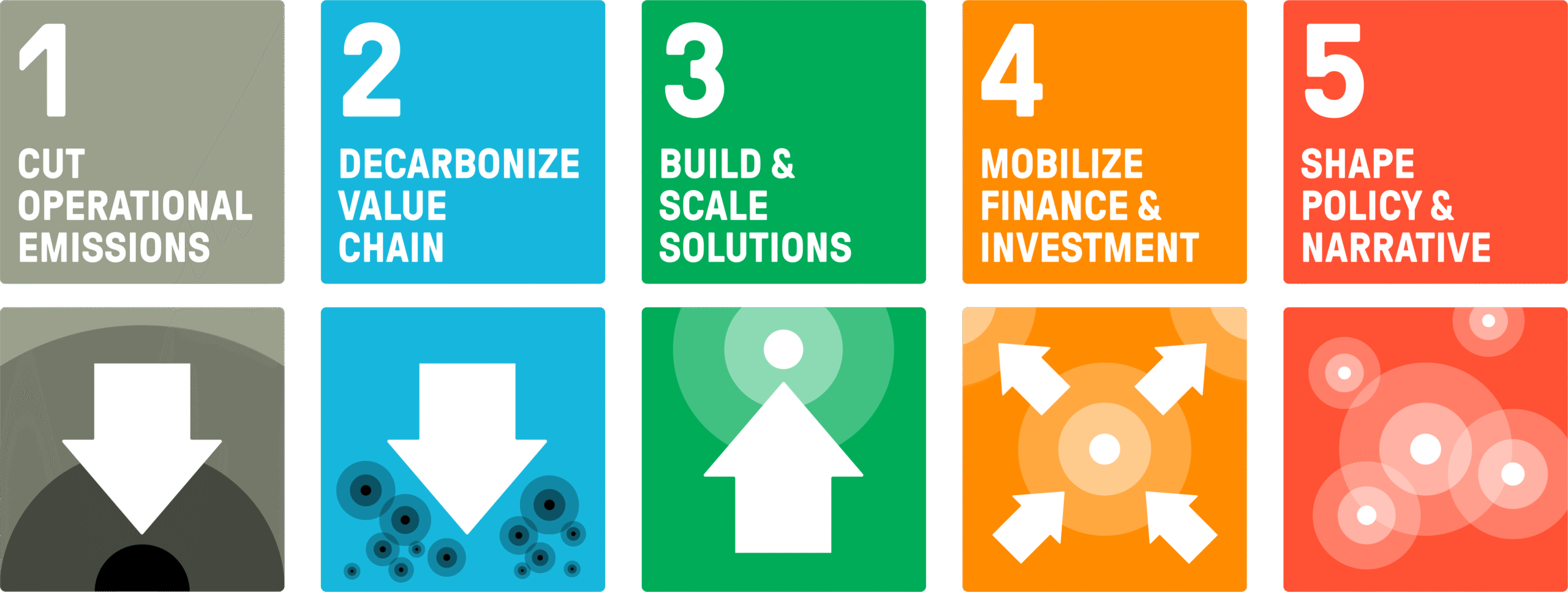
The pillars don’t work in isolation, they reinforce each other. With Pillar 3, by building and scaling climate solutions, companies create the low-carbon products, services, and business models that help decarbonise their customers’ value chains. Pillar 4 accelerates this by mobilising the finance and infrastructure for scaling those solutions. Pillar 5 shapes the environment in which all of this happens: strong policy and public narratives reduce the risks for early movers, unlock markets, and makes climate leadership the norm. Together, the five pillars form a self-reinforcing system. Each one makes the others more effective, and all of them lead in the same direction: global net zero.

The Action Blocks: Where strategy meets action
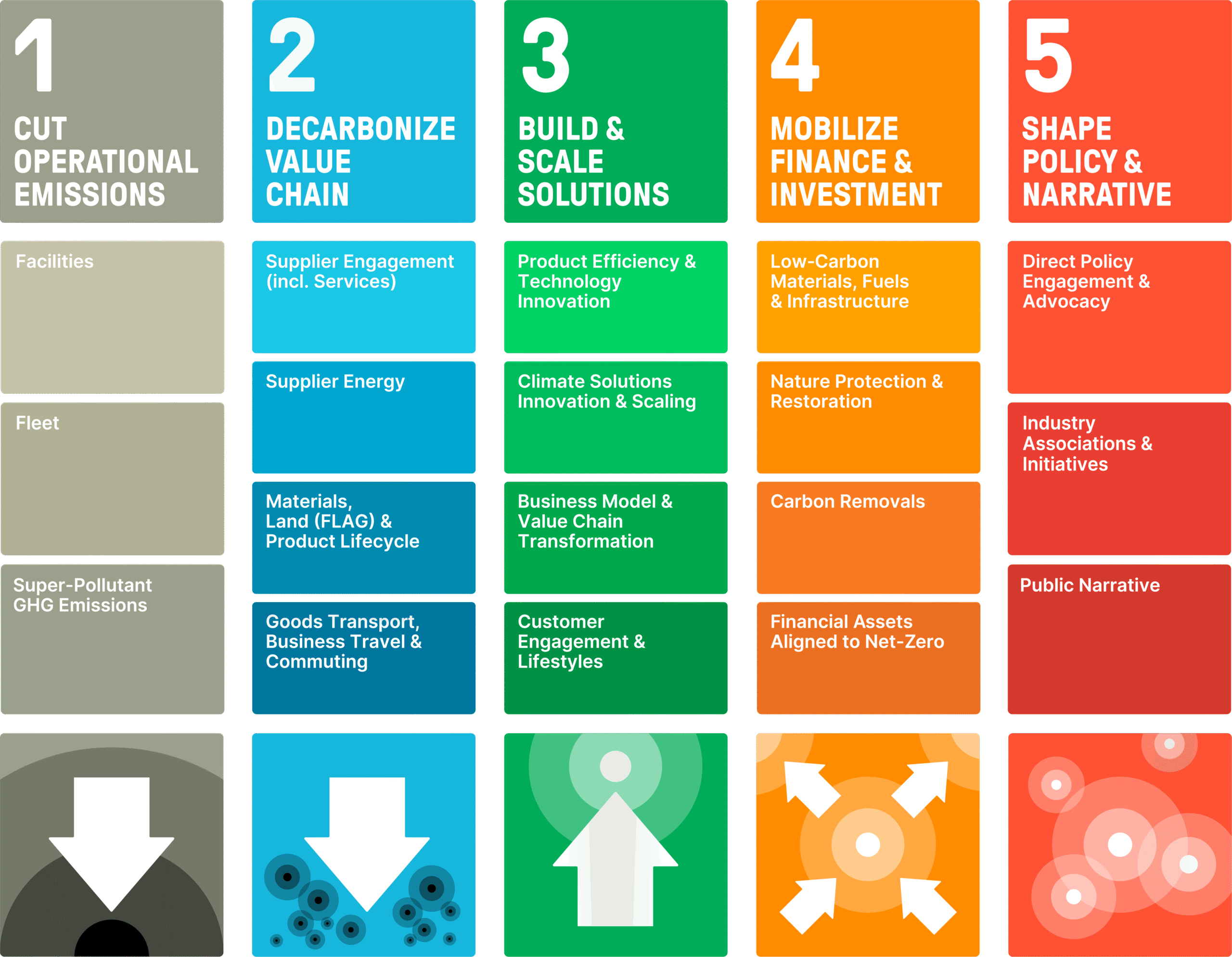
Each pillar contains specific Action Blocks, discrete areas in which companies can set targets, take action and measure progress. No company will excel at all of them from day one. But each company can identify where their greatest leverage lies, prioritise accordingly, and expand the scope of their action over time.
The Five Pillars of Exponential Framework

Pillar 1: Cut Operational Emissions
A credible climate strategy begins with your own operations. Scope 1 and 2 emissions, from your facilities, your fleet, and the super-pollutants you release. The science is clear: companies aligned with global net zero halve these emissions every ten years.
Action Blocks
Facilities: reduce emissions from your buildings, facilities and everyday operations.
Fleet: transition company-owned and operated transport fleet to low-emission vehicles.
Super-pollutant GHG emissions: identify and reduce high-impact greenhouse gases such as methane and refrigerants.

Pillar 2: Decarbonise Value Chain
For most companies, Scope 3 emissions in the value chain often represent the largest share of their total footprint and must therefore be addressed.
Action Blocks
Supplier engagement (incl services): work with suppliers and service providers to set targets, improve reporting and reduce emissions.
Supplier energy: support suppliers in transitioning to renewable energy and improving energy efficiency.
Materials, land (FLAG) & product lifecycle: reduce emissions from materials, agriculture, land use, forestry and product lifecycles.
Goods Transport, business travel & commuting: lower emissions from logistics, freight, business travel and employee commuting.

Pillar 3: Build & Scale Solutions
Beyond cutting your emissions lies a bigger opportunity: accelerating the solutions the world actually needs. Pillar 3 is about using your company’s core capabilities, your products, services, business models, and customer relationships, to scale low-carbon alternatives.
This is where climate action becomes a growth strategy. The companies that build the solutions driving decarbonisation will define the new net zero economy.
Action Blocks
Product efficiency & technology innovation: improve product efficiency and advance low-carbon technologies to drive decarbonisation.
Climate solutions: innovation & scale: develop, invest in, and scale products and services that deliver climate solutions.
Business model & value chain transformation: transform business models and value chains towards alignment with global net zero.
Customer engagement & lifestyles: enable and encourage customer decisions aligned with a sustainable net zero future.

Pillar 4: Mobilise Finance & Investment
Where money flows, the economy follows. Companies direct vast capital flows: through investment decisions, treasury management, pension funds and lending relationships. Pillar 4 calls on every company to align those financial flows with a net zero future.
This means backing clean technology, funding nature, purchasing high-integrity carbon removals, and ensuring that every financial asset under your influence is working toward net zero, not against it.
Action Blocks
Low carbon materials, fuels & infrastructure: invest in the infrastructure, materials and fuels needed for the low-carbon transition.
Nature protection & restoration: invest in the protection and restoration of natural ecosystems and biodiversity.
Carbon removals: invest in high-integrity carbon dioxide removals to address residual emissions.
Financial assets aligned to net zero: Reduce the emissions funded by cash and financial assets, aligning them with the climate ambition.

Pillar 5: Shape Policy & Narrative
Markets are shaped by rules, incentives, and culture, and companies have enormous power to influence all three. Pillar 5 calls on businesses to use their voice, their associations, and their platforms to drive the systemic change that no single company can achieve alone.
This means lobbying for climate ambition. It means holding industry associations accountable for advocating for science-aligned policies. And it means using marketing and communications to normalise low-carbon choices in culture, not just in strategy documents.
Action Blocks
Direct policy engagement & advocacy: reduce emissions funded by cash and financial assets, and align with the transition to net zero.
Industry associations & initiatives: engage directly with policymakers and advocate for policies that align with a credible pathway to global net zero.
Public narrative: ensure your industry associations and initiatives are aligning towards global net zero.
Read more about the Exponential Framework in the Exponential Business Playbook.