
By the Exponential Roadmap Initiative
To halve global emissions by 2030, we must rapidly decarbonise the foundational materials of our modern economy, such as steel, cement, and chemicals. The good news is that we largely know how to do this. Across these sectors, viable low-carbon production technologies already exist – from green hydrogen-based steelmaking and electrochemical cement to electrification, low-carbon feedstocks, and energy efficiency in chemical production.
The bad news is that we are struggling to finance them at the speed and scale required.
During London Climate Action Week, the Exponential Roadmap Initiative (ERI) convened a roundtable of corporate buyers, producers, researchers, and NGOs to tackle this bottleneck. The consensus was clear: the primary barrier in hard-to-abate sectors is not a lack of technological options, but a lack of market infrastructure to make those options bankable.
To bridge this gap, we need a mechanism that connects companies willing to invest in the scaling of low-carbon technologies with the producers who need capital to build and scale the necessary infrastructure. That mechanism is commodity certificates, also known as Environmental Attribute Certificates (EAC). As low-carbon solutions scale, increased investment, production efficiencies and economies of scale should bring down their costs, making them increasingly competitive with conventional alternatives.
Commodity certificates should therefore be seen as a bridge, not a destination. Physical procurement of low-carbon materials should always remain the priority and, as the supply of low-carbon commodities grows and becomes more geographically distributed, the need for certificates should diminish. A well-designed certificate system should ultimately work towards its own obsolescence.
The momentum is real. The SBTi recently launched its Net-Zero Standard v2.0, which for the first time formally recognises the use of market instruments for part of a company’s Scope 3 footprint. Major deals are being struck: large tech companies have signed binding offtake agreements with producers of green steel and cement, committing to purchase the environmental attributes of low-carbon material they cannot yet physically source.
At the same time, the mechanism is not without its critics. Questions about double counting, additionality and the risk of greenwashing are legitimate and must be taken seriously. For many hard-to-abate sectors, such as steel, cement, and chemicals, commodity certificates are still a new and unfamiliar instrument, with no established registries, limited accounting sectoral criteria, and significant uncertainty about how claims will be recognised by standard-setters and regulators.
This is precisely the moment to get the design right.
The Tracing and Transport Challenges in Hard-to-Abate Sectors
In a perfect world, a company committed to net-zero would simply buy a low carbon commodity (e.g., green steel, green cement, green chemicals) directly from a supplier, physically tracing the low-carbon material into their own products. But the physical realities of sectors such as heavy industry and its supply chains make this incredibly difficult, and in some cases, impossible.
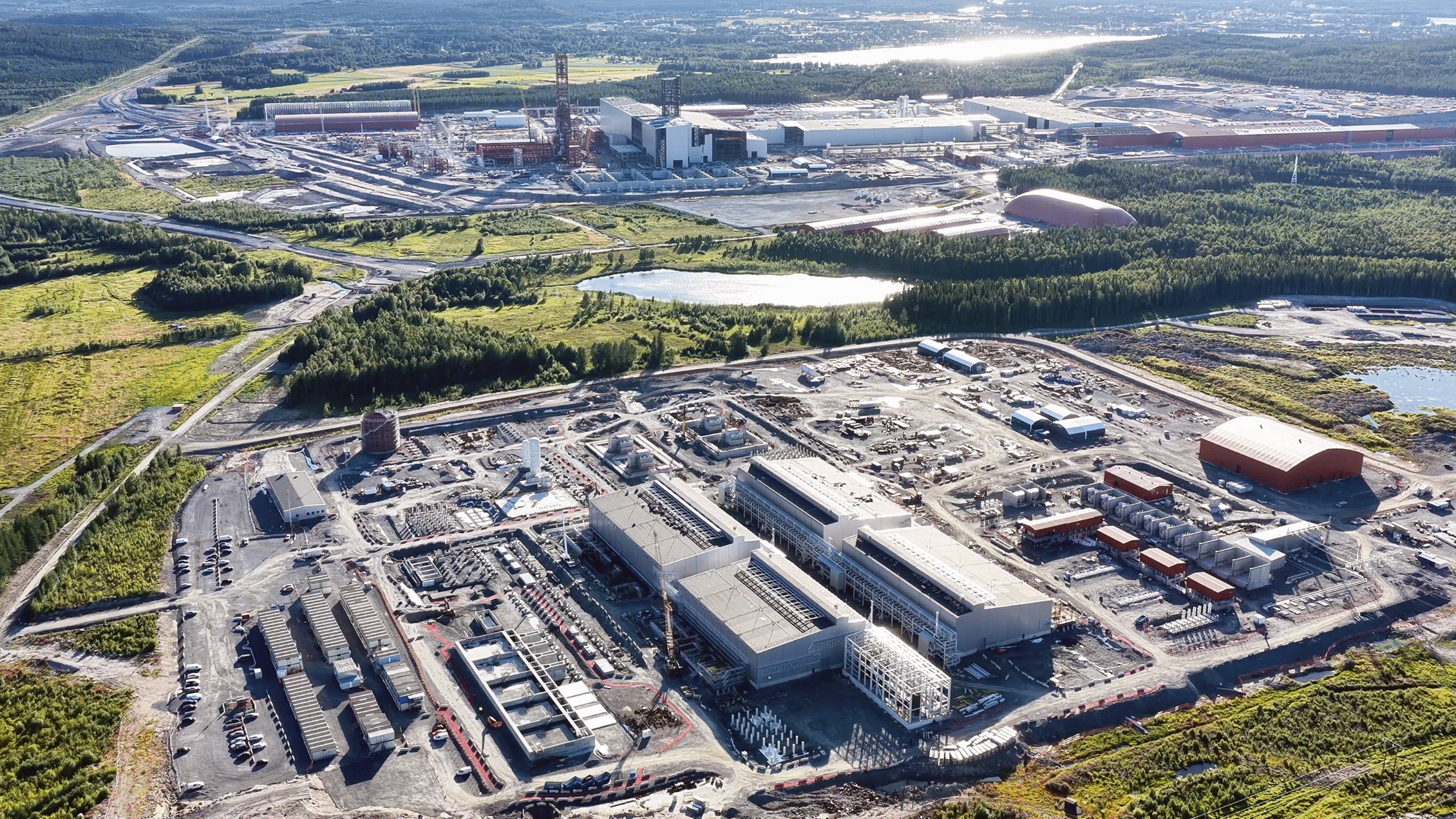
Photo: Stegra
Take steel. Green steel production is today concentrated in a handful of pioneering facilities. Most global buyers are geographically distant from these producers and cannot yet access green steel through their existing supply chains. The physical product can be transported, but the supply is simply not yet where the demand is.
Take cement. It is heavy, cheap, and close to impossible to ship over long distances — not only because of the carbon cost of transport, but because cement is a perishable material that is made locally to its point of use. Today, only a handful of start-ups produce ultra-low carbon cement. The alternative to commodity certificates would be to build a green cement plant next to every data centre, every office block, every construction site that wants to use it — which is simply not realistic in the early days of a nascent industry.
Take chemicals. The supply chain is notoriously complex. A single molecule might move through multiple transformations, companies, and borders before reaching a final consumer product. Physically segregating a “green” molecule from a conventional one throughout this web is a logistical nightmare.
This is where commodity certificates come in. By decoupling the environmental attribute (e.g. the emission factor and corresponding emissions reduction) from the physical product, commodity certificates create a way for buyers to pay for the environmental value of lower-carbon production without needing to purchase or physically receive the product itself. This means a buyer in North America can purchase certificates linked to the production of green cement in Europe, for example, creating a revenue stream that helps the producer finance and scale the lower-carbon production. Similarly, a company can support the decarbonisation of a chemical plant halfway across the world without taking delivery of its physical products. The physical product remains local, while the environmental attribute can be transferred and accounted for separately, allowing demand for lower-carbon production to mobilise capital and accelerate global decarbonisation.
As a researcher from Imperial College London noted during our roundtable, this mechanism removes a critical barrier to investment and scale by overcoming the limitations of physical segregation and direct sourcing.
Funding the “Green Premium”
Building the first generation of near-zero emissions solutions is an expensive and risky business. A producer of green steel at the roundtable highlighted that securing the billions required to build their ground-breaking infrastructure relies on proving to investors that there is guaranteed demand.
While policy instruments (e.g. EU policy frameworks) provide some support, they are currently insufficient to cover the current “green premium”, i.e. the extra cost today of producing the green material compared to the fossil-fuel incumbent.
Commodity certificates provide a crucial, additional revenue stream. By signing offtake agreements for commodity certificates, corporate buyers provide the guaranteed demand signals that producers need to reach Final Investment Decision (FID). In the case of green steel, while 80–90% of the product may be sold physically to European manufacturers, the remaining environmental attributes can be sold as commodity certificates to global buyers, creating the demand needed to bring the plant to execution phase.
Building Trust and Integrity
Despite their potential, commodity certificates face a significant hurdle: public trust. Scarred by the controversies of the Voluntary Carbon Market (VCM), stakeholders are rightly wary of anything that sounds like an “accounting trick” or a license to keep polluting.
It is vital to preserve the integrity of commodity certificates. A commodity certificate does not represent an avoided or reduced emission elsewhere in the economy (like protecting a forest despite not having forestry in your supply chain); it represents a verified, physical shift within a relevant industrial value chain.
To ensure this integrity, participants from leading NGOs and academia, but also from the companies working with selling or buying commodity certificates, stressed that the market must rapidly build out four pillars of infrastructure:
- Common accounting frameworks: clear rules and guidance on baselines, additionality, and retirement, ensuring a buyer knows exactly what they are purchasing, as well as how market instruments are recognized.
- Digital registries: interoperable, transparent registries that track the issuance, transfer, and retirement of certificates to guarantee that a single reduction is never double-counted.
- Sector-specific nuance: while the high-level principles of integrity must be universal, the specific rules must be tailored to the realities of each sector (e.g., cement vs. chemicals).
- Neutral governance: shared forums where buyers, producers, verifiers, and standard-setters can develop the rulebooks and resolve disputes.
An additional point, learned from the Sustainable Aviation Fuel (SAF) market, where book-and-claim has operated for several years, is that no single actor can build a credible commodity certificate market alone. The model of producer + independent NGO + committed buyer was held up as a template. Producers bring deep knowledge of their emissions data but cannot set the rules for their own market without inviting accusations of self-interest. Buyers bring demand signals and commercial credibility but need independent verification to defend their claims. NGOs and research institutions bring the technical expertise and public trust needed to develop methodologies that will withstand scrutiny. As commodity certificates expand into new sectors, this collaborative model must be the default.
The Cost of Waiting
The most urgent takeaway from the roundtable was the danger of letting perfect be the enemy of the good. The recent launch of the SBTi Net-Zero Standard v2.0 – which for the first time formally recognises the use of market instruments for part of a company’s footprint – provides momentum. Yet standard-setters are still clarifying exactly how these instruments will count toward Scope 3 targets, and companies need to know urgently.
We cannot afford to wait. If we want green steel and green cement plants operational by 2030, the contracts must be signed today. In the next 6–12 months, the priority should be to establish credible, end-to-end pilots, i.e. a small number of high-quality use cases with independent verification and registries, testing the full transaction chain, from baseline calculation to buyer claim and audit.
Over the following 1-3 years, the goal should be to move from isolated pilots to sector-wide platforms with shared issuance and retirement rules, interoperable registries, and a neutral governance body. Those who move first will not only secure supply and build relationships with the most advanced producers, but will also help shape the rules of a market that is going to exist regardless.
Commodity certificates are not a shortcut around physical decarbonisation. When designed with integrity, they can be one of the fastest routes for achieving it.
