
By the Exponential Roadmap Initiative
At Climate Week NYC 2026, the Exponential Roadmap Initiative (ERI), Oatly and Beyond Meat convened business, finance and civil society leaders to explore a critical challenge for the climate transition: how do we create the market conditions that allow climate solutions to compete, scale and become the default?
Through a public panel at Solutions House and a closed-door executive roundtable, a common picture emerged of the climate solutions landscape today. Demand for climate action already exists. Many of the solutions, technologies, products and business models needed to reduce emissions already exist. The challenge is connecting the two by creating the market conditions that enable climate solutions to succeed.

Photo by: Barak Shrama
The day began with a public panel featuring Katarina Wangler Björk, Chief Impact Officer at ERI, Erin Augustine, VP Global Sustainability at Oatly, Jaclyn Allen, Head of ESG at Beyond Meat, Darshana Myronidis, Global Sustainability Expert, and Mark Hertsgaard, Executive Director of Covering Climate Now.
Drawing on findings from The 89 Percent Project, the discussion explored the significance of the finding that 89% of people worldwide want governments to do more to address climate change. The conversation highlighted a growing disconnect: widespread public demand for climate action exists alongside a rapidly expanding ecosystem of lower-emission products and services, yet the link between the two remains weak. A central question emerged: how can public support for climate action be translated into stronger demand signals for the solutions that can help deliver it?
“The challenge is no longer proving that climate solutions exist. Across sectors, the technologies, products and business models needed for the transition are already emerging. The next challenge is creating the market conditions that enable those solutions to scale and become the default.”
Katarina Wangler Björk, Chief Impact Officer, Exponential Roadmap Initiative
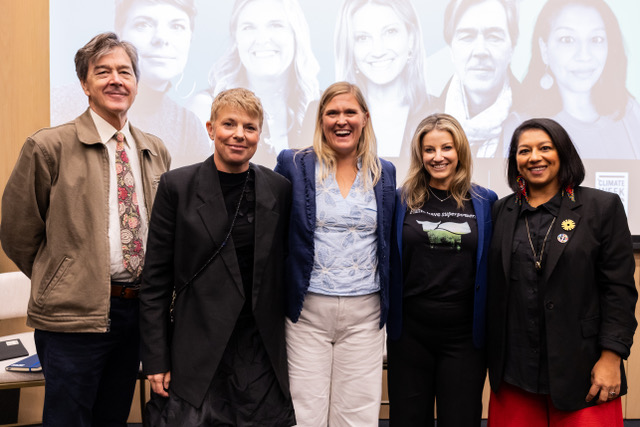
Photo by: Barak Shrama
That message continued during an executive roundtable with climate solution providers and leaders from across business, finance and civil society.
Participants discussed a persistent gap in today’s markets. It is not enough for a product or service to perform better from a climate perspective. Climate solutions must also compete for customer attention, procurement opportunities, investment and access to capital. Yet many existing market mechanisms do not consistently recognise or reward their contribution to emissions reductions across the wider economy.
A recurring theme was the need for stronger market signals. Before markets can reward climate solutions, they need credible ways to identify them. Clearer standards, procurement criteria and investment frameworks can help buyers and investors distinguish solutions delivering substantial climate impact and direct capital toward them. The Climate Solutions Framework was highlighted as one example of an approach designed to address this challenge through a consistent and credible methodology.
“I’m excited that a majority of people globally want climate action at the same time as more climate solutions are emerging. Together, these are the ingredients needed for a movement. When it comes to shifting our food system, our research shows that scaling food solutions requires making it easy for consumers by creating food environments where climate solutions are the norm rather than the alternative. Of course, there are challenges we need to tackle to make this possible, including creating a level playing field and addressing widespread health and sustainability misinformation, but I remain optimistic!”
Erin Augustine, VP Global Sustainability, Oatly
Participants also reflected on the changing expectations surrounding climate leadership. As scrutiny of sustainability claims increases, organisations are moving beyond broad commitments toward more rigorous demonstrations of impact. Alongside this shift, there is growing interest in frameworks that recognise not only a company’s operational emissions reductions, but also its contribution to scaling climate solutions and enabling wider system transformation.
One message stood out across both sessions: climate leadership cannot be measured solely by which companies reduce emissions fastest. It must also recognise which products, technologies and business models help accelerate emissions reductions across the wider economy.
“It’s important to recognise companies that deliver immediate climate benefits, alongside those pursuing ambitious long-term climate goals. We need businesses committed to responsible growth and to accelerating emissions reductions across the wider economy. By rewarding climate solution companies and products, we can direct more resources toward the innovations needed to accelerate the transition to a low-carbon economy.”
Jaclyn Allen, Head of ESG, Beyond Meat
The discussions pointed to a simple but powerful insight. Demand for climate action already exists. Many climate solutions already exist. The task now is connecting the two through stronger recognition, procurement, investment and policy signals.
When markets recognise and reward climate solutions, they have a stronger basis to compete, attract investment and scale. For participants at Climate Week NYC, that represents the next phase of climate action: not finding solutions, but helping them become the default choice.
